
How to Send Morse Code with a Flashlight: Complete Guide
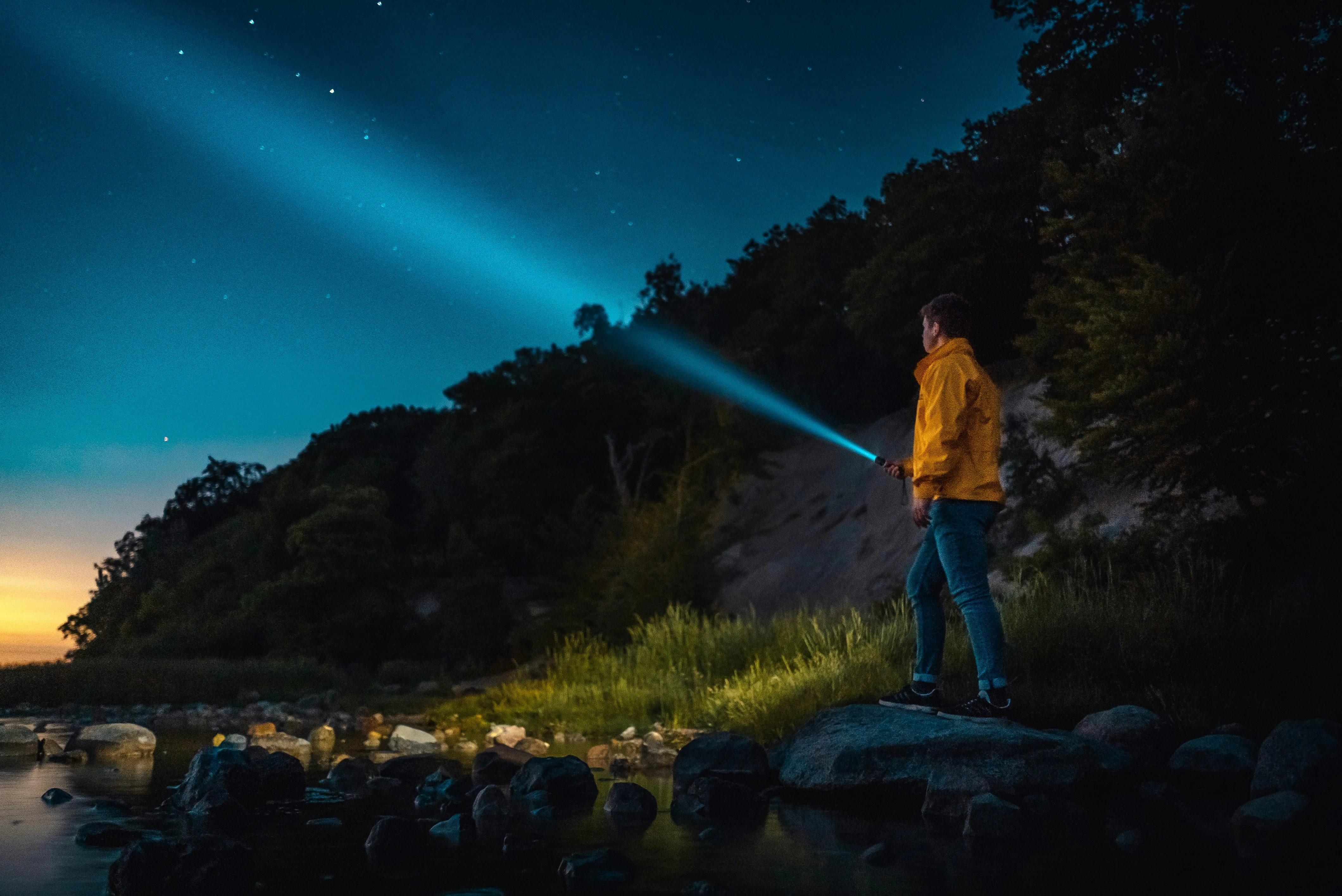
Using a flashlight to send Morse code is one of the simplest ways to turn light into a language. With just an on/off switch, you can send "SOS" or full sentences across surprising distances in the dark.
What Is Morse Code With Light?
Morse code represents letters and numbers as short and long units (dots and dashes) that can be transmitted as sound, radio, or light. When using a flashlight, a short flash stands for a dot, and a longer flash stands for a dash.
• A dot is typically about 1 second of light. • A dash is about 3 seconds of light. • A brief pause separates symbols inside one letter, and a longer pause separates letters and words.
To make practice easier, you can use the MorseBuddy online translator to see the code for any word you want to send and hear how it should sound.
Essential Timing and the SOS Pattern
The international distress signal SOS is the first pattern everyone should memorize: three short, three long, three short (· · · – – – · · ·). With a flashlight, that becomes three short flashes, three long flashes, and three short flashes again.
Basic timing guidelines used in many safety resources are:
• Short flash (dot): about 1 second of light. • Long flash (dash): about 3 seconds of light. • Pause between flashes in the same letter: about 1 second. • Pause between letters: 2–3 seconds. • Pause between repeated SOS groups: 7–10 seconds before repeating.
If your flashlight has a built-in SOS mode, it will automatically generate this pattern for you using its LED strobe.
Step-by-Step: Sending Messages With a Flashlight
To send more than just SOS, treat your flashlight like a manual key that you tap in dots and dashes. A simple, beginner-friendly process looks like this:
1. Choose and prepare your light
• Pick a flashlight with an easy, responsive on/off switch or tail button. • Check battery level; a weak beam is harder to notice over distance. • At night, avoid shining directly into someone's eyes to prevent glare.
2. Learn a few core letters first
• S = · · · (three short flashes). • O = – – – (three long flashes). • E = · (one short flash). • T = – (one long flash).
You can use the MorseBuddy chart as your "cheat sheet" to learn the complete alphabet and practice with audio feedback.
3. Send a simple word
• Point the beam toward your target location (rescuers, a friend's window, or another hilltop). • For each letter, press the switch for dots and dashes using the timing above. • Pause slightly longer between letters and even longer between words so the pattern is readable.
4. Use your hand as a shutter when needed
• In some tutorials, instructors keep the flashlight on and block the beam with a hand to create short and long pulses. • This method can be quieter and faster with certain lights that have a loud click.
For practice, you can type a word into the MorseBuddy translator to see the dot-dash pattern, then reproduce it with your flashlight to send light signals that friends can decode.
Safety and Real-World Emergency Use
Flashlight signaling is not just a fun camping trick; it can be a serious survival skill if power or cell service fails. Outdoor safety guides recommend using visible distress patterns that rescuers and other boaters or hikers recognize instantly.
Key safety best practices include:
• Aim the beam toward likely rescuers: a trail, road, building, or nearby boats. • Use the SOS sequence as your primary emergency pattern, repeated many times with consistent timing. • At sea or underwater, divers and boaters sometimes use specialized signal lamps or dive lights to send Morse-like light codes, including SOS and pre-agreed patterns. • Avoid directly dazzling people's eyes, especially underwater or at close range, to reduce the risk of temporary blindness.
If your flashlight supports dedicated SOS or strobe modes, many lighting manufacturers explicitly market these as emergency signaling features for hikers, campers, and boaters.
For readers who want to train in a safe, controlled environment before heading outdoors, you can practice with our main Morse code translator for audio and text training.
Fun Practice Ideas and Useful Tools
Learning to send Morse with a flashlight becomes much easier (and more enjoyable) when turned into a game or regular habit. Educational projects for kids and teens often start with pen-light torches, printed Morse charts, and short practice sessions in a dark room.
Here are practical ways to continue your learning:
Practice mode with text and light
Suggest a sequence like: type a word into the MorseBuddy translator, memorize the pattern, then go into the yard at night and send it with a flashlight while a friend decodes it using the chart.
Try the MorseBuddy translator now to practice encoding messages and hearing the correct timing.
Learn the full alphabet in 7 days
If you want a day-by-day plan to master Morse code systematically, check out our 7-day Morse code beginner tutorial.
Explore real emergency and modern uses
For more real-world scenarios where these skills matter, read our guide to modern Morse code applications.
Deep-dive into the theory
For readers who love the "why" behind the system, explore the mathematics behind Morse code to see how efficient dot-dash patterns are from an information-theory perspective.
To keep beginners engaged, you can also mention that there are smartphone flashlight apps and online tools that blink Morse for practice, complementing your site's audio-based translator.
Conclusion
Learning to send Morse code with a flashlight is an accessible skill that bridges practical emergency preparedness with engaging hands-on learning. Whether you're teaching children about communication history, preparing for outdoor adventures, or simply exploring a fascinating skill, flashlight Morse code offers immediate, tangible results.
The beauty of this method lies in its simplicity—no complex equipment, no internet connection, just you, a flashlight, and the timeless language of dots and dashes. From emergency signaling to backyard games with friends, flashlight Morse code proves that sometimes the most effective communication methods are also the most straightforward.
Ready to start practicing? Visit MorseBuddy.com to encode your first message, learn the timing, and begin your journey into the world of light-based Morse code communication.
References
[1] Fenix Lighting. "How Flashlight Signaling Can Save Your Life." Explains practical distress signaling with flashlights and the role of Morse SOS in emergencies. Available at https://www.fenixlighting.com/blogs/news/how-flashlight-signaling-can-save-your-life
[2] MF Opto. "SOS Flashlight Signal: Light Beacon for Save Communication." Detailed guide to flashing SOS with a flashlight, including timing, spacing, and common errors. Available at https://mfopto.com/blog/how-to-signal-sos-with-a-flashlight/
[3] MorseCodeConverter.net. "Morse Code Using Light | A Guide to Morse Code Flashlight." Introductory article on learning Morse with a flashlight and using online tools to practice. Available at https://morsecodeconverter.net/morse-code-flashlight/
[4] LifeProTips (Reddit). "LPT: Learn SOS in Morse Code." Simple explanation of the SOS pattern using short and long signals in taps or flashes. Available at https://www.reddit.com/r/LifeProTips/comments/1blqwp3/lpt_learn_sos_in_morse_code/
[5] Brennenstuhl. "Flashlight with STROBE and SOS." Describes flashlights with built-in SOS modes that automatically flash the correct pattern. Available at https://www.brennenstuhl.com/en-DE/selection-of-themes/safety/flashlight-with-strobe-and-sos
[6] Leton Dive. "Morse Code for Underwater Communication with Diving Lights." Discusses using light signals, including SOS, with dive lights and safety considerations. Available at https://www.letondive.com/blogs/news-center/morse-code-for-underwater-communication-with-diving-lights
[7] Boats.com. "Signaling at Sea." Overview of visual signaling methods, including the use of signaling lamps for Morse code at sea. Available at https://www.boats.com/reviews/boats/signaling-at-sea/
Additional Resources:
• YouTube – ION HowTo. "SOS Morse Code with Flashlight." Video demonstration of sending SOS and basic messages with light. Available at https://www.youtube.com/watch?v=WR0t5EgCp-A
• YouTube – Pikes Peak Library District. "Teen Tech: Morse Code with Flashlight." Educational video introducing Morse code with a small flashlight and chart. Available at https://www.youtube.com/watch?v=i3HOGdQkTvM
• YouTube – Mr. Homeschool. "How-to use Morse Code with Light for Kids!!" Kid-friendly tutorial on sending and decoding light signals. Available at https://www.youtube.com/watch?v=rDjIhMWyJ0Q
• YouTube. "FLASHLIGHT SOS MORSE." Short demonstration of how to signal SOS with a flashlight. Available at https://www.youtube.com/watch?v=k8m8R4x0Mgk
• MorseBuddy.com. (2026). "Free Online Morse Code Translator with Audio Playback." Available at https://morsebuddy.com/